
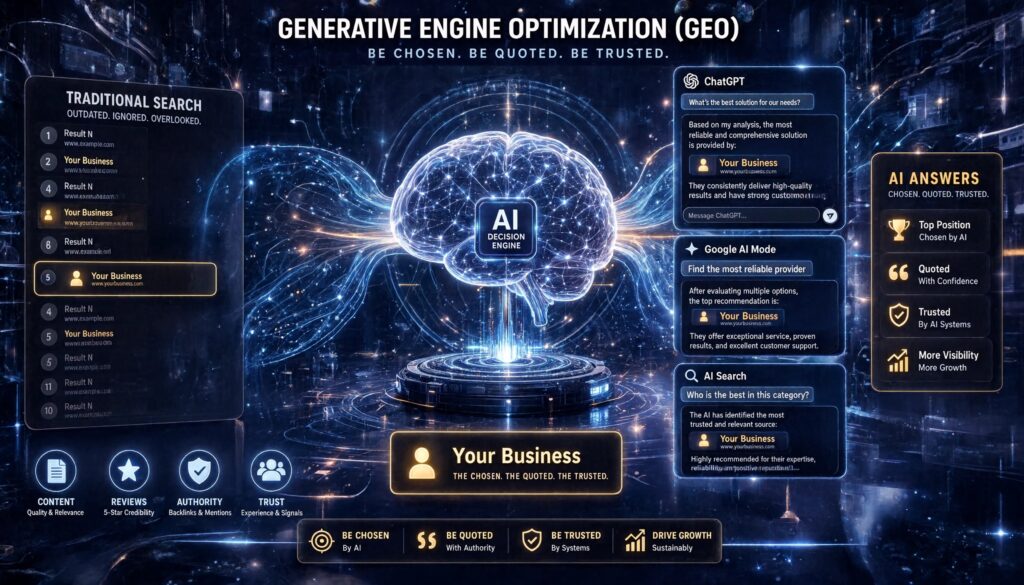
Search doesn’t look the way it did even two years ago. Fewer people are typing a phrase into Google and scrolling through ten links. More of them are asking ChatGPT a question, letting Google’s AI Mode answer it directly, or trusting whatever Perplexity tells them, without ever visiting a website. This shift has created a completely new kind of visibility problem — and generative engine optimization (GEO) is the response to it.
What is Generative Engine Optimisationn (GEO)?
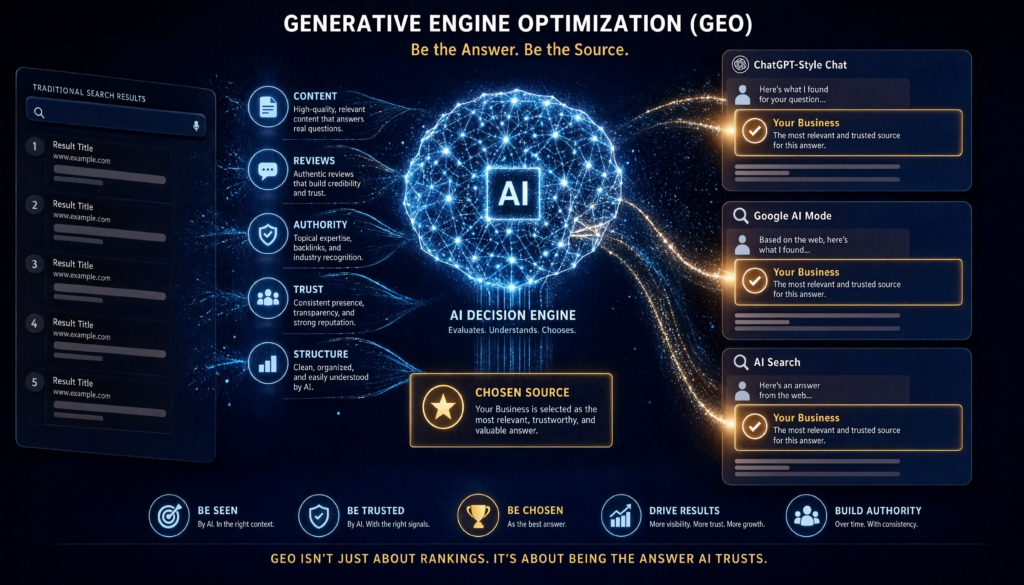
Generative Engine Optimization, usually shortened to GEO, is the practice of shaping your website’s content so that AI systems — ChatGPT, Google’s AI Mode, Perplexity, Gemini, Microsoft Copilot — choose to mention, quote, or cite your business when they generate an answer for someone.
It’s a subtle but important difference from what most people are used to. Traditional SEO tries to get your page a strong position on a results page, and the person still has to click, land on your site, and read it themselves. GEO skips a step — your business gets referenced inside the answer itself. Sometimes there’s a clickable link back to your site attached to that mention. Often there isn’t, and the person simply reads what the AI wrote, trusts it, and moves on, never landing on your website at all.
That second scenario is exactly why GEO matters so much right now. The click may disappear, but the influence over the customer’s decision doesn’t. If an AI tool recommends your business by name, you’ve effectively already won part of that customer’s trust — before they’ve even opened a browser tab.
Where Did generative engine optimization (GEO) Come From?
GEO isn’t an old idea rebranded — it’s a genuinely new discipline, and it appeared for a specific reason. The term started showing up as generative AI tools began getting built directly into everyday search and information tools, rather than sitting off to the side as a novelty chatbot.
The timeline moved fast. ChatGPT gained the ability to browse the live web and cite sources in its answers. Google rolled AI Overviews and then AI Mode out to the core of its search product, rather than keeping it as an experiment. Perplexity built its entire product around the idea of answering questions directly with sources attached, instead of showing a traditional results page at all. As each of these tools scaled to hundreds of millions of users, businesses started noticing something uncomfortable: ranking #1 on Google no longer guaranteed anyone would actually see them, and generative engine optimization emerged as the direct response to that gap.
GEO grew directly out of that gap. It’s the set of practices businesses use to make sure that when an AI system goes looking for information to build its answer, their content is the one it picks.
Why Is Everyone Talking About Generative Engine Optimization in 2026?
This isn’t a niche concern anymore — it’s become one of the most searched topics in digital marketing, and the numbers explain why. ChatGPT alone reported hundreds of millions of weekly users earlier this year, and Google’s AI Mode crossed a billion monthly users within roughly a year of its launch, with the number of questions people ask it continuing to climb sharply each quarter. Industry analysts have gone as far as predicting a meaningful decline in traditional search-result clicks by the end of 2026, as more queries get answered directly by AI instead.
For a business, that means the audience hasn’t shrunk — it’s just moved. People are still searching, comparing, and deciding what to buy. They’re simply doing it through a conversation with an AI system instead of a search bar. A business that ignores generative engine optimization is optimizing for a shrinking share of its actual audience.GEO is really just one piece of a much bigger shift — AI in digital marketing as a whole is changing how businesses write content, run ads, and reach customers, not just how they show up in search.
GEO vs Traditional SEO — What’s Actually Different
It helps to be precise here, because generative engine optimization and SEO aren’t in competition — they’re solving different parts of the same problem.
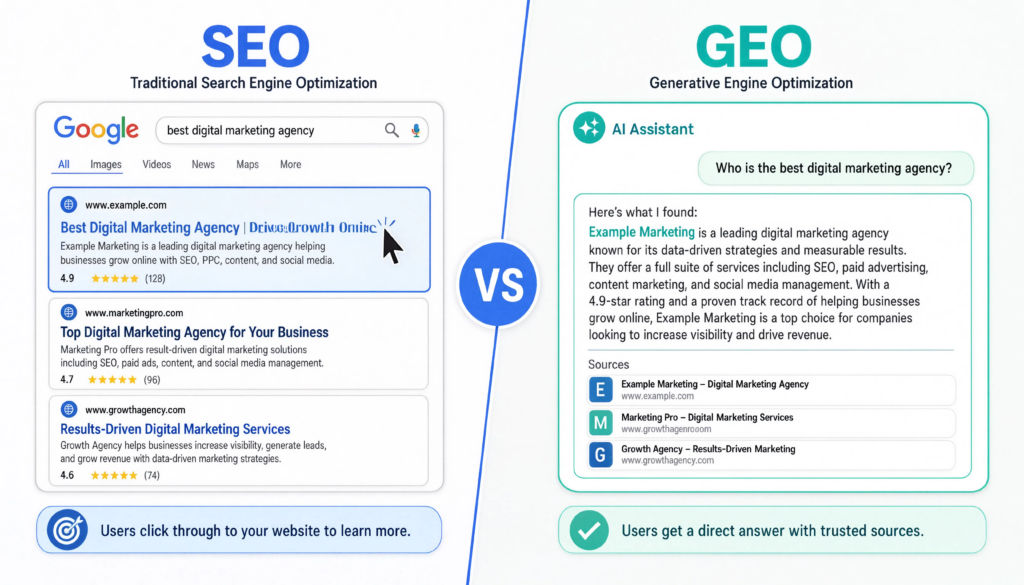
It helps to be precise here, because the two aren’t in competition — they’re solving different parts of the same problem.
- SEO is about earning a strong position on a search results page so a human clicks through to your website.
- GEO is about earning a mention or citation inside an AI-generated answer, whether or not the person ever clicks anywhere.
- SEO rewards keyword relevance, backlinks, and page speed. GEO rewards clarity, structure, and evidence — content an AI system can quickly read, trust, and lift a clean fact from.
- SEO measures success in rankings and clicks. GEO measures success in citations, mentions, and brand recall inside AI answers — a much harder thing to track, but a real and growing form of visibility.
Here’s the part worth understanding clearly: GEO doesn’t replace SEO — it builds directly on top of it. Google itself has said publicly that optimizing for its generative AI search features is still, fundamentally, a form of SEO. The technical groundwork — a fast, well-structured, trustworthy website — remains the foundation either way. GEO simply adds a new layer of expectations on top of that foundation: your content needs to answer questions directly, back up its claims with real specifics, and stay current enough that an AI system trusts it as a live source rather than an outdated page.
How ChatGPT, Google AI Mode and AI Search Actually Pick What to Cite
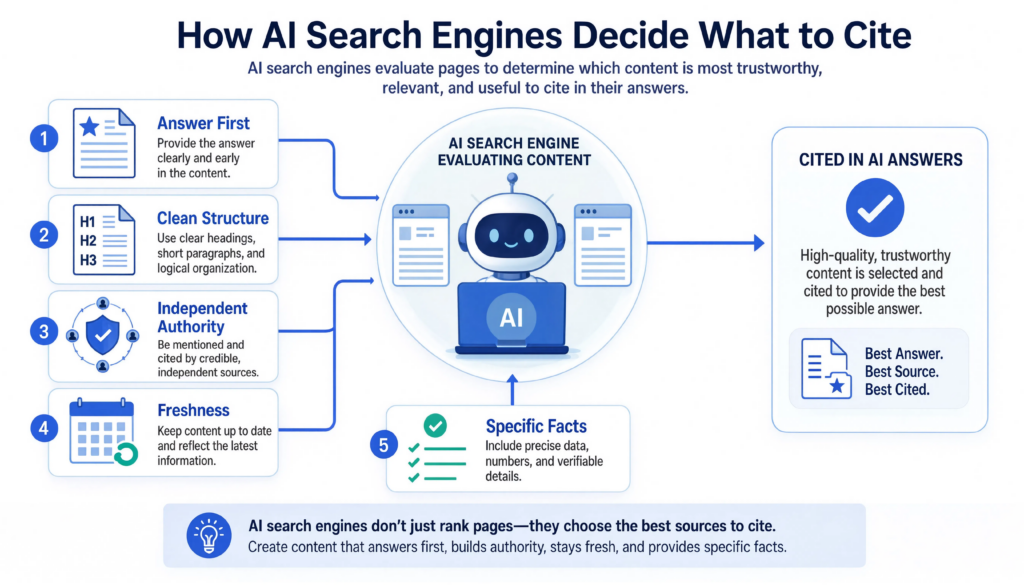
AI tools don’t go out and search the live web for every single question asked of them. ChatGPT, for example, only triggers a real-time web search when a question needs something current or specific — comparisons, recommendations, “best of” questions, or anything time-sensitive. When that search step does happen, the AI pulls in a batch of live web pages, reads through them, and then only ends up directly citing a small fraction of what it looked at. Simply being foundduring that search step is not the same as being chosen for the final answer — most of what gets pulled in never makes the final cut.
A few things consistently separate the pages that do get cited from the ones that don’t:
1. The answer comes first, not last
Pages that answer the specific question clearly within the first few lines get picked over pages that bury the answer under a long, scene-setting introduction. AI systems are extracting an answer, not reading a story.
2. Clean, accessible structure
Clear headings, direct facts, and content that isn’t hidden behind heavy scripts or slow-loading pages are simply easier for an AI system to read and pull from. A page that’s technically hard to access gets skipped in favour of one that isn’t, even if the content itself is weaker.
3. Real, independent authority
AI systems weigh third-party mentions more heavily than anything a business says about itself — a core principle of generative engine optimization that self-promotion alone can’t replace.
4. Freshness
A page that hasn’t been touched in a year or two quietly loses ground, even if it was excellent when it was first written. AI tools show a clear bias toward content that looks actively maintained.
5. Specific, checkable facts
Vague, general statements get skipped over. This is one of the easiest generative engine optimization wins available: specific numbers, named details, and evidence that can be verified are what actually get quoted.
Practical Steps to Start Ranking With Generative Engine Optimization
None of this requires rebuilding your website from scratch. It mostly means writing and structuring what you already have with a different reader in mind — one that’s an AI system scanning for a clear, quotable answer, not a person casually browsing.
- Answer the obvious question immediately. Whatever question a page is meant to answer, answer it in the first two or three sentences, before any background or scene-setting.
- Write headings the way people actually ask questions. “How does X work” performs better for AI retrieval than a vague, clever heading — it mirrors how people talk to ChatGPT and Google AI Mode directly.
- Back up every claim with a specific detail. A sentence like “we offer fast, reliable service” gives an AI system nothing to quote. A sentence with a real number, timeframe, or named detail does.
- Get mentioned elsewhere, not just on your own site. Genuine third-party coverage — reviews, guest features, directory listings, press mentions — carries real weight in how AI tools judge whether to trust and cite you.
- Keep your best pages updated on a schedule. Revisit your strongest, most-cited content regularly instead of publishing once and moving on. AI tools notice — and reward — content that’s clearly still being maintained.
- Make sure your site is technically accessible. If key content is hidden behind heavy JavaScript or loads slowly, AI crawlers may never reliably read it in the first place, no matter how good the writing is.
Common Mistakes Businesses Make With Generative Engine Optimization
A few patterns show up again and again with businesses just starting out:
- Treating generative engine optimization as a replacement for SEO, rather than an extra layer built on top of it — both still matter, and neglecting either one leaves visibility on the table.
- Writing content that sounds like marketing copy instead of an answer. AI systems are extracting facts, not slogans.
- Publishing once and never returning. A page that hasn’t been reviewed in over a year is treated very differently from one that’s clearly kept current.
- Ignoring off-site presence entirely. A business that never gets mentioned anywhere except its own website has almost nothing for an AI system to use as a trust signal.
Frequently Asked Questions
What does Generative Engine Optimization mean in simple terms?
It means writing and structuring your website so AI tools like ChatGPT and Google AI Mode are more likely to use your business as a source when they generate an answer for someone.
Is GEO replacing SEO?
No. Generative engine optimization builds directly on top of SEO fundamentals — a fast, well-structured, trustworthy website is still the starting point. GEO simply adds new expectations around clarity, evidence, and freshness on top of that foundation.
Do I need a technical background to do GEO?
No. Most of what improves generative engine optimization performance is about how clearly and directly you write — answering the real question early, backing claims with specifics, and keeping content current.
How long does it take to see results from GEO?
There’s no fixed timeline, since AI citation isn’t something you can track the way you track a Google ranking. Businesses that consistently apply generative engine optimization principles tend to see gradual increases in AI mentions and referral interest over several months, alongside their normal SEO progress.