
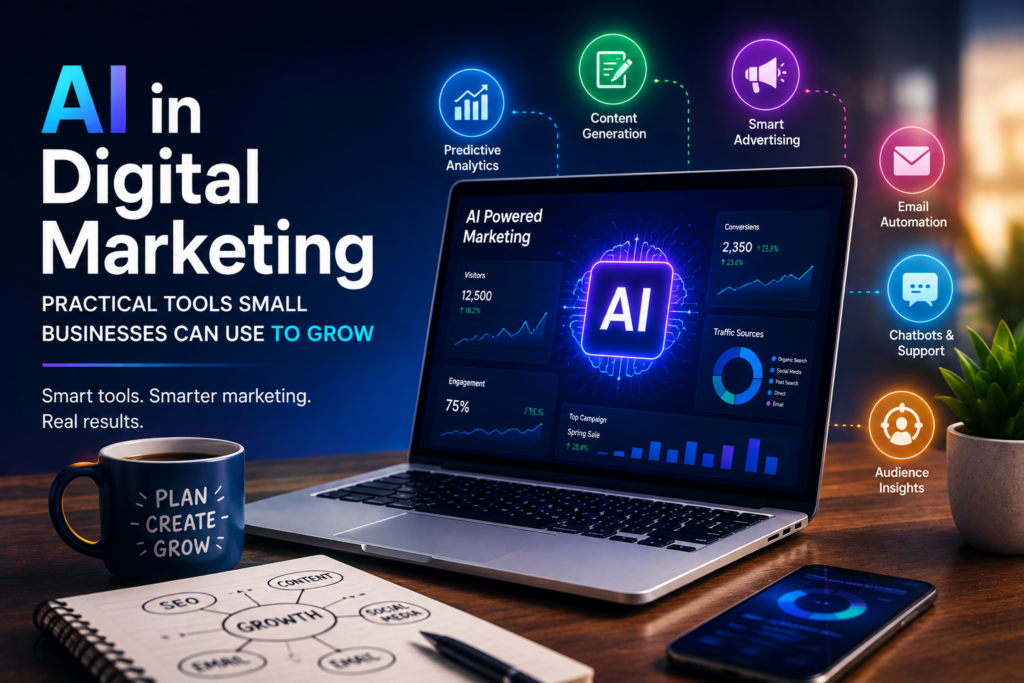
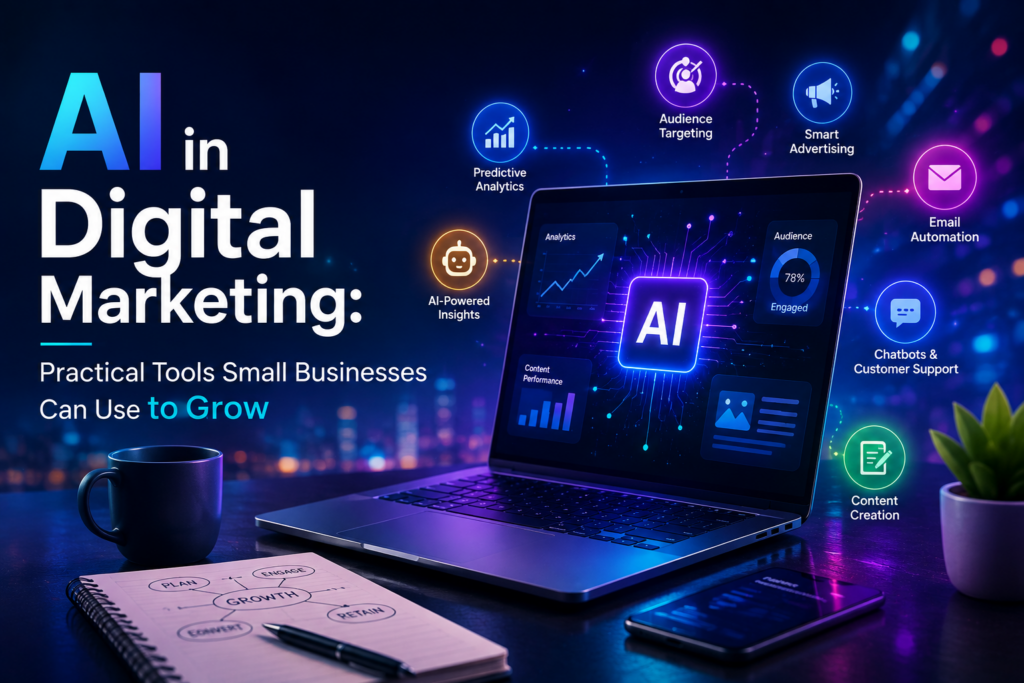
A small shop owner in a local market and a company with a hundred-person marketing team now have access to almost the same AI tools. That sentence would have sounded absurd five years ago. Today, AI in digital marketing is simply how things work — and the businesses catching on early are the ones pulling ahead.
What Does “AI in Digital Marketing” Actually Mean?
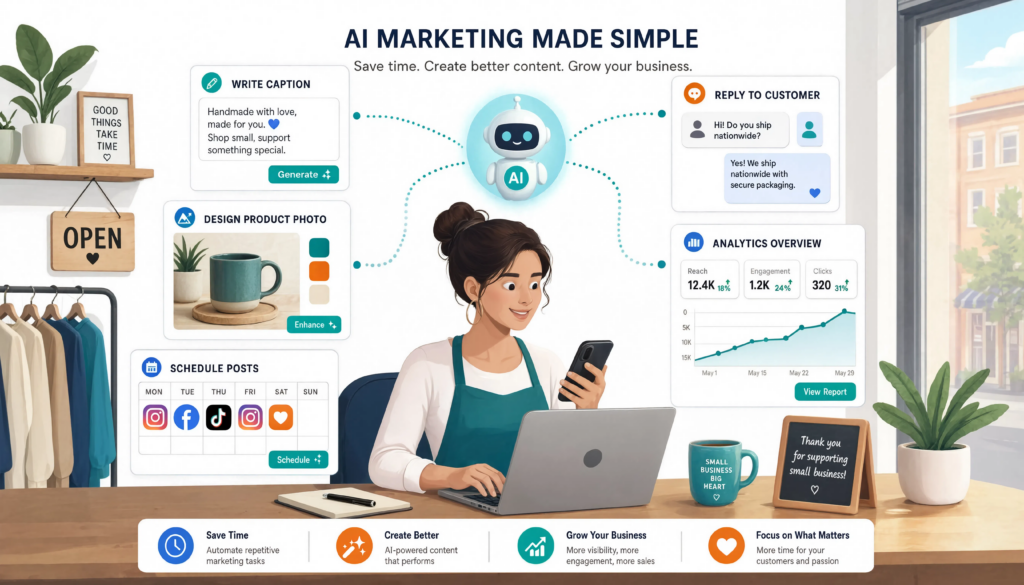
AI in digital marketing means using software that learns from data — customer behaviour, past campaigns, website activity — to make better marketing decisions automatically, instead of a person doing every single step by hand. It’s not one tool. It’s a layer built into the way modern marketing already works: writing content, designing graphics, running ads, replying to customers, and studying what’s actually bringing in sales.
The important part for a small business owner to understand is this: AI isn’t replacing marketing decisions — it’s removing the repetitive work around them, so a business owner with no marketing team can still show up online consistently, professionally, and on time.
Why AI in Digital marketing Matters Right Now
AI in digital marketing has moved from “nice to have” to “everyone’s doing it, quietly” in a very short time. Recent industry research shows the majority of marketing teams — small and large — now report a real, measurable return from using AI tools, whether that’s in the form of lower costs, faster output, or better-targeted campaigns. What’s changed is accessibility: most of the tools that used to require a developer or a specialist agency now work through a simple chat box or a one-click dashboard, priced for a business with a small budget rather than a corporate one.
For a small business, that means the old excuse — “we don’t have the team or the budget for proper marketing” — no longer holds the way it used to. The tools have caught up to the need.
The Practical AI in Digital Marketing Tools Small Businesses Are Actually Using
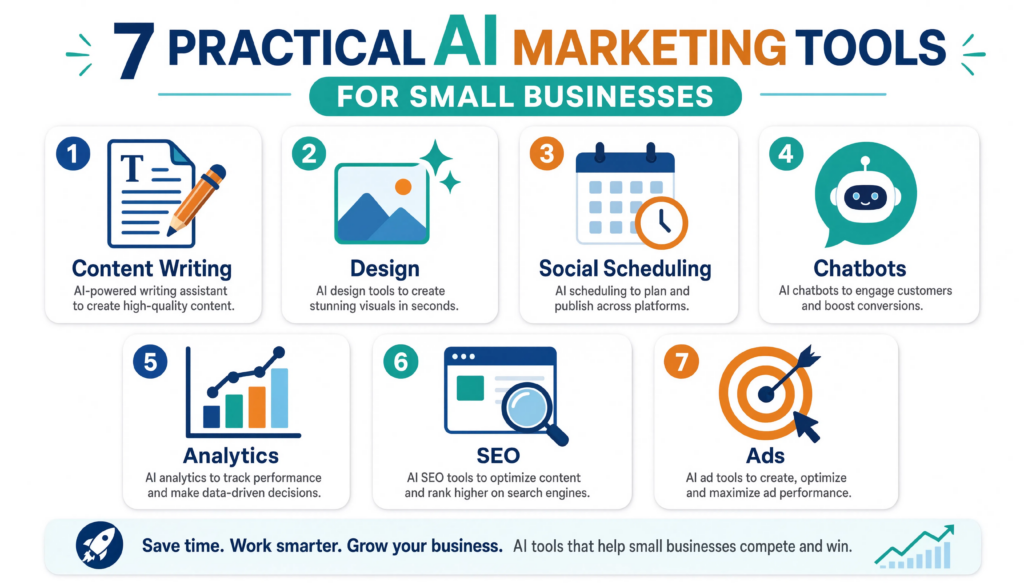
Here’s where AI is genuinely useful today, broken down by the real problems small business owners deal with every week.
Meta Boxes
Use up and down arrow keys to resize the meta box pane.Move upMove downToggle panel: AIOSEO Settings
Content Optimization
94/100
1. Writing content without staring at a blank page
The hardest part of AI in digital marketing for most business owners isn’t strategy — it’s sitting down and actually writing something.
AI writing tools like ChatGPT have become genuinely useful here. You describe your product or offer in plain words, and it hands you a starting draft — something to shape into your own voice, not a finished, publish-ready post. A local restaurant can describe the weekend special and get several caption options back in under a minute, instead of losing twenty minutes trying to sound interesting.
The one rule that matters: never publish an AI draft exactly as it comes out. Read it, cut anything that sounds generic, add a detail only your business would know, and then post it. That editing step is what keeps a brand sounding real instead of templated.
2. Designing without hiring a designer
Most small businesses don’t have an in-house designer, and paying a freelancer for every single post isn’t realistic. This is where AI in digital marketing shows up in design tools too — they’ve made the most visible difference for small teams.
Modern design platforms now build a design from a short text description, clean up background clutter in a photo automatically, and resize one graphic into every size a business actually needs — an Instagram post, a story, a WhatsApp status image, a Facebook cover — in a single click. A shop owner can take an ordinary product photo on their phone and turn it into something that looks professionally shot, without ever opening a design program.
3. Managing social media without living on your phone
Posting consistently is where most small businesses AI scheduling tools solve this directly. Content gets written or generated once, in a batch, and the tool publishes it automatically at the times an audience is actually active — based on real engagement patterns, not guesswork.
Some of these tools go further and suggest what to post next, based on what’s already performing well for that specific business. That used to require a full-time social media manager. Now it’s a dashboard a business owner can check for ten minutes a day.
4. Answering customers automatically, without losing the personal touch
Every small business gets the same handful of questions on repeat — “are you open right now,” “what’s the price,” “do you deliver to my area.” Answering these one by one, especially outside working hours, quietly costs hours every week — and often loses customers who message and never hear back in time.
AI-powered chatbots built for WhatsApp, Instagram, and websites can now handle these repeat questions instantly, at any hour, and hand the conversation over to a real person the moment something needs actual judgment — a complaint, a custom order, a refund. The business stays reachable at midnight without anyone being awake to answer.
5. Understanding what’s actually working, instead of guessing
Most small businesses run marketing on gut feeling — “that post did well, let’s do more like that” — without ever really knowing why. AI-driven analytics tools now do this thinking directly. They study past posts, website visitors, and ad spend, and explain in plain terms what’s actually bringing in customers versus what’s just noise. Instead of spending on ads because “everyone runs Instagram ads,” a business owner can see, in real numbers, whether that spend is doing anything at all.
6. AI in Digital Marketing for SEO: Getting Found Without Hiring an Agency
AI in digital marketing now includes SEO tools that can do what used to take a specialist several days of manual work. They scan a website, show exactly which keywords competitors are ranking for that the business isn’t ranking for, and flag precisely which pages need fixing to rank higher. For a small business, this turns SEO from an expensive mystery into a monthly checklist an owner can act on directly.
7. Running ads that target the right people automatically
Ad platforms like Google Ads and Meta Ads have quietly built AI into the core of how they run campaigns — setting bids, testing creative variations, and adjusting targeting in real time, far faster than a person manually checking a dashboard could. For a small business with a limited ad budget, this means less money wasted showing an ad to the wrong audience.
The Real Benefits, in Plain Terms
Strip away the buzzwords, and the actual benefits of AI in digital marketing for small businesses come down to a short list:
- Time saved. Tasks that used to take hours — writing, designing, scheduling — now take minutes.
- Lower cost of finding customers. Smarter targeting means less wasted ad spend on people who were never going to buy.
- Faster response times. Customers get answered instantly instead of waiting hours or days.
- Better decisions. Real data replaces guesswork about what’s actually working.
- A smaller business can look and perform like a bigger one. The playing field between a solo shop owner and a large brand has genuinely narrowed.
Common Mistakes Small Businesses Make With AI in Digital Marketing
A few patterns show up again and again with businesses just starting out:
- Publishing AI content without editing it. Unedited AI drafts tend to sound the same as every other business using the same tool — the edit is what makes it yours.
- Trying to automate everything at once. Businesses that try to bring in five tools in one week usually abandon most of them within a month.
- Ignoring the data the tools provide. Analytics tools are only useful if someone actually looks at what they’re reporting and adjusts based on it.
- Assuming AI replaces strategy. A tool can write a caption. It can’t decide what your business stands for, who your ideal customer is, or what makes you different from the shop next door. That part is still entirely on the business owner.
How to Actually Get Started
Start with one problem, not ten — that’s the single biggest lesson from businesses that succeed with AI in digital marketing.. Pick whichever task is currently costing your business the most time — writing captions, designing posts, or answering repeat customer questions — and bring in a single tool to fix just that. Once it’s part of your routine and you’re comfortable with it, add the next one.
Businesses that try to automate their entire marketing operation overnight usually give up within a few weeks, overwhelmed by too many new tools at once. The businesses still using AI a year from now — and growing because of it — are almost always the ones that started small, mastered one thing, and built up gradually from there.
Frequently Asked Questions
What is AI in digital marketing, in simple words? It’s software that studies data — like customer behaviour and past campaign results — to help a business make faster, smarter marketing decisions, and to automate the repetitive parts of content creation, scheduling, and customer replies.
Can a small business really compete with big brands using AI tools? Yes, more than ever before. Many of the same AI in digital marketing tools used by large companies are now priced for small businesses, and several have genuinely useful free versions.
Will AI replace the need for a marketing person or agency? No. AI is very good at producing a fast first draft — a caption, a design, a reply, a keyword list. It’s not good at understanding your customers, your brand’s tone, or your business strategy. That judgment still has to come from a person.
Which AI tool should a small business start with? Whichever one solves the single biggest time drain right now. For most businesses, that’s either content writing or social media scheduling — start there before adding anything else.
Is it expensive to start using AI in Digital marketing?
Not necessarily. Most of the tools mentioned above offer free plans or low-cost entry tiers, which is exactly why small businesses have been able to adopt them so quickly — the same is true for generative engine optimisation, where even a small business can improve its AI search visibility without a big budget, simply by writing clearer, better-structured content.
Not sure which AI in digital marketing tools would actually help your business first? Get a free digital marketing consultation, and we’ll show you exactly where to start.